Overview
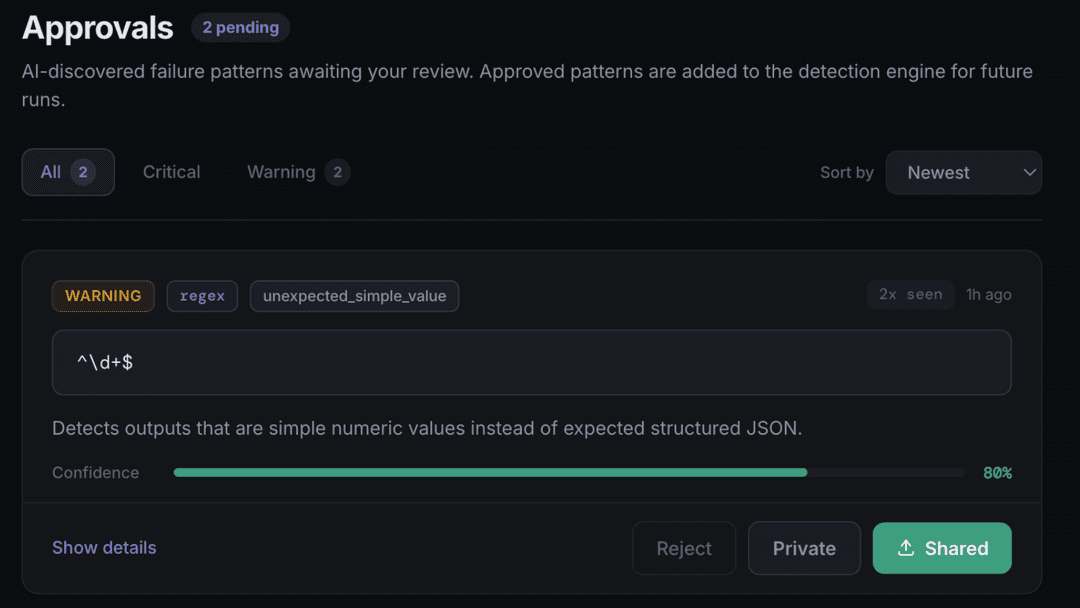
ARGUS learns from your runs. When the semantic judge discovers a new failure pattern, it proposes a candidate signature. You review it in the Approvals page and choose: Private (local only) or Shared (synced to all ARGUS users via cloud).
Expensive LLM analysis discovers patterns once. Cheap heuristic matching catches them forever after.
How It Works
- Discovery — the LLM investigator analyzes a failure and extracts a reusable pattern
- Proposal — the pattern is saved as a candidate in
.argus/candidates.jsonwith confidence, evidence, and reasoning - Review — open
argus ui, go to the Approvals page. Each candidate shows the pattern, match strategy, severity, confidence score, and source evidence - Approval — approve as Private (local only) or Shared (synced to all ARGUS users via cloud)
- Detection — the approved pattern is loaded into the heuristic engine and matched against every future node output
Three-Tier Signature Registry
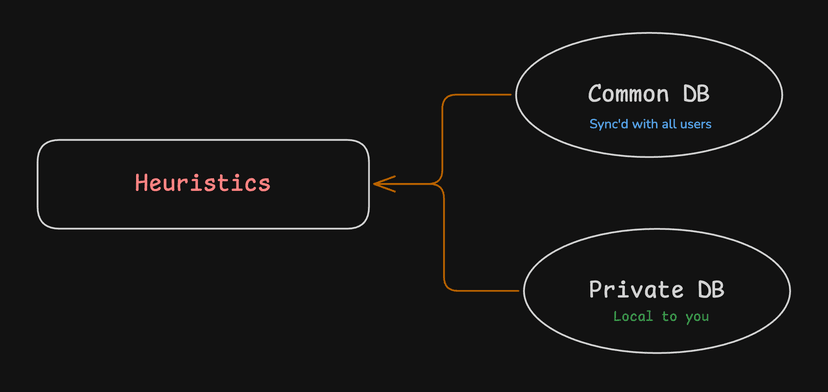
The heuristic engine loads signatures from three sources, merged and deduplicated at startup:
- ‣Bundled — ships with ARGUS. Core patterns for placeholder outputs, semantic degradation markers, corrupted JSON, and repeated filler text.
- ‣Private— patterns you approved as "Private". Stored locally in
.argus/custom_signatures.json. Only your instance uses these. - ‣Shared— community-contributed patterns synced from the cloud. When you approve a pattern as "Shared", it gets pushed to the cloud database and becomes available to every ARGUS user.
Deduplication
(pattern, match_strategy) — the most specific version wins. No pattern runs twice.Semantic Judge Override
The heuristic engine is fast but context-blind — it matches patterns without understanding meaning. A cookie-baking agent that outputs "I cannot find the flour" would trigger the "I cannot" refusal pattern, even though it's a legitimate response.
When semantic_judge=True, the LLM judge runs afterheuristic detection and can override false positives. It reviews the full input/output context and clears flags that don't hold up under semantic analysis.
Approvals UI
The Approvals page in argus ui has three tabs:
- ‣Pending — candidates discovered by the LLM investigator, awaiting your review
- ‣Private — your locally approved patterns
- ‣Shared — community patterns synced from the cloud
# Open the UI and navigate to Approvals
argus ui

# Cloud sync requires login
argus login
Human-in-the-loop